Look near the red cross, not directly at the rings: the rings seem to slowly turn.
Try this
- Keep looking at the cross and let the rings sit in your side vision.
- Blink, or move your eyes around the pattern: the motion restarts.
- Tick Make it grayscale and even to remove the steps and the motion stops.
Why it happens
Jocelyn Faubert and Andrew Herbert described the peripheral drift illusion in 1999. It needs repeated steps of brightness (dark, mid, light) and your side vision. Your visual system processes high-contrast and low-contrast edges at slightly different speeds, and when your eyes make small movements or you blink, those timing differences read as motion in one direction. That is why it works best a little away from where you are looking.
Did you know?
Many famous "rotating" patterns use this effect. The one here is drawn fresh in code for this site.
References
- Faubert J., Herbert A. (1999). The Peripheral Drift Illusion: A Motion Illusion in the Visual Periphery. Perception, 28, 617-621. doi:10.1068/p2825
- Background on Wikipedia
The illusion on this page is drawn by code written for this site. Last checked 1 November 2026.
Frequently asked questions
Why does the still image look like it is moving?
Brightness steps are processed at slightly different speeds, which reads as motion in your peripheral vision.
Try these next
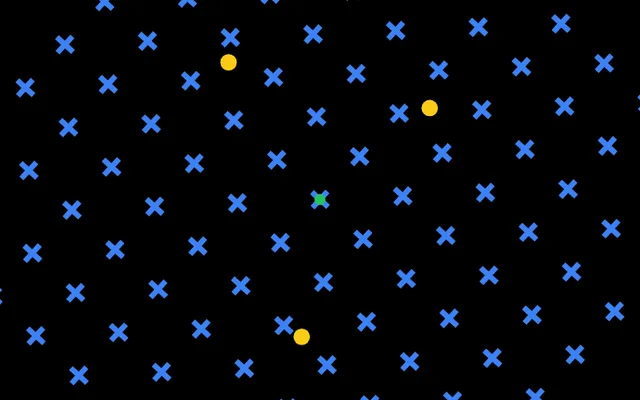 MotionMotion-induced blindness
Three bright yellow dots disappear while a blue pattern turns behind them.
 MotionPinna-Brelstaff rings
Two rings of squares seem to spin in opposite directions as the picture zooms in and out.
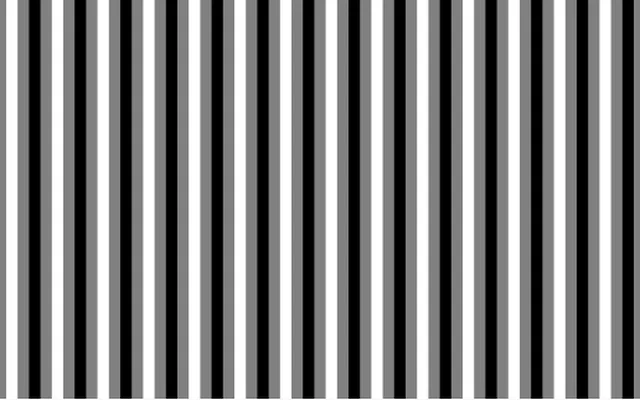 MotionStepping feet
Two bars moving at the same steady speed seem to take turns stepping, like feet.