Move your eyes around, or jiggle the picture, and the central disk seems to drift separately from the background, as if it sat on a different layer.
Try this
- Tick Jiggle the picture: the disk seems to wobble on its own.
- Change Shape of the bricks: long thin bricks make it stronger.
Why it happens
When the picture moves a little, the long bricks give your motion system mixed signals: along a long edge it can only tell the motion across the edge, not along it. The background bricks run one way and the bricks in the disk run the other, so the two areas send different motion estimates and seem to move separately. Trevor Hine, Michael Cook and Garry Rogers showed in 1995 that the effect depends on the size and orientation of the pattern.
Did you know?
Japanese artist Hajime Ouchi published the pattern in a 1977 book of graphic designs, and vision scientists later adopted it.
References
- Hine T., Cook M., Rogers G. (1995). An illusion of relative motion dependent upon spatial frequency and orientation. Vision Research, 35, 3093-3102. doi:10.1016/0042-6989(95)00075-b
- Background on Wikipedia
The illusion on this page is drawn by code written for this site. Last checked 1 November 2026.
Frequently asked questions
Why does the circle move?
The two areas send different motion signals when your eyes move, so they seem to slide apart.
Try these next
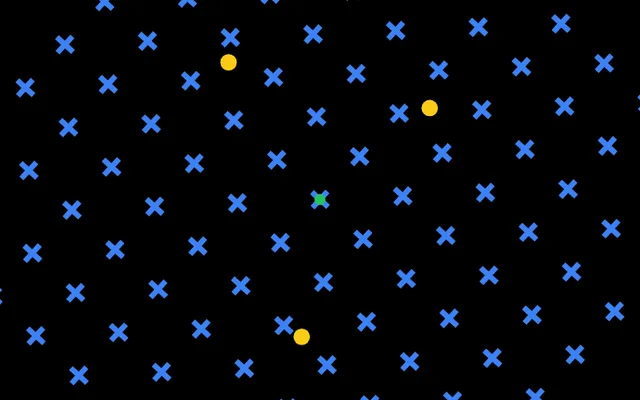 MotionMotion-induced blindness
Three bright yellow dots disappear while a blue pattern turns behind them.
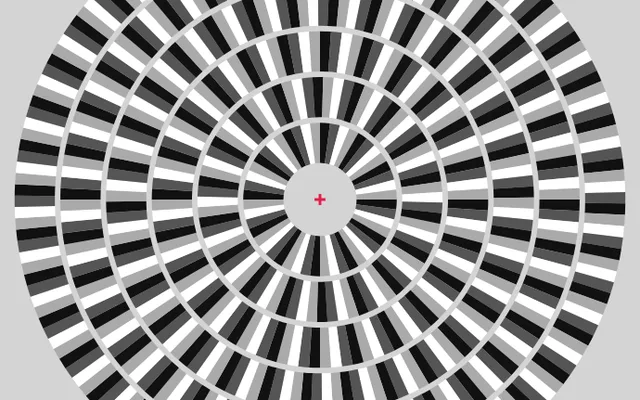 MotionPeripheral drift
A still pattern seems to rotate in the corner of your eye.
 MotionPinna-Brelstaff rings
Two rings of squares seem to spin in opposite directions as the picture zooms in and out.